Hemlock has completed Phase 1 of live testing.
From March through July 2026 the actively-traded book returned +37%
on deposited capital — roughly +160% annualized. Active trading is now intentionally
paused while we redesign and scale the system for Phase 2, at a higher level of investment.
What you're seeing below reflects that pause, not inactivity: only a couple of positions remain
open (being wound down), and the account value has been deliberately flat since August. Phase 1's
gains came from hands-on management of a live book; Phase 2's engine — the Canopy research
ensemble — has since been built and validated in a 12-month walk-forward simulation, and the
current work is hardening its research and screening layers before new capital deploys. Nothing
trades live until it earns its way through that gauntlet.

Total account value · Kalshi & Polymarket
$2,864.54
+$17.76
(+0.62%)
past 24h
Kalshi + Polymarket ($2,550 · cached 2026-09-02) marks · as of 9/2 12:09 AM PT · refreshes each load (≤1 min)
Cash
$2,550.60
settled, ready to deploy
In positions
$313.94
2 open markets
Deposited
$2,092.39
lifetime, since Mar 2026
Net P&L
+$772.15
+36.9% on deposits
+138% annualized
Value over time
Total value
Contributed (deposits)
Deposit
Sale — realized gain
the gap between the two lines is trading gains
Chart tracks the combined Kalshi + Polymarket account. Snapshots record both venues from 9/01/26; before that, the Polymarket segment is shown at its net-deposit value (it was barely traded, so the approximation is within a few dollars). The late-August dip-and-recovery is an internal transfer — capital withdrawn from Kalshi and redeposited to Polymarket — and the contributed line moves with it, so the gap between the two lines stays honest trading gains. Solid line: live hourly marks (since Jul 2, 2026). Dashed: reconstructed from trade history — positions at cost, value stepping only at deposits, trades, and settlements (May 4 onward; the Mar–Apr era, under $300 total, is beyond Kalshi's export window). Reconciles with the live balance to the cent.
System Design
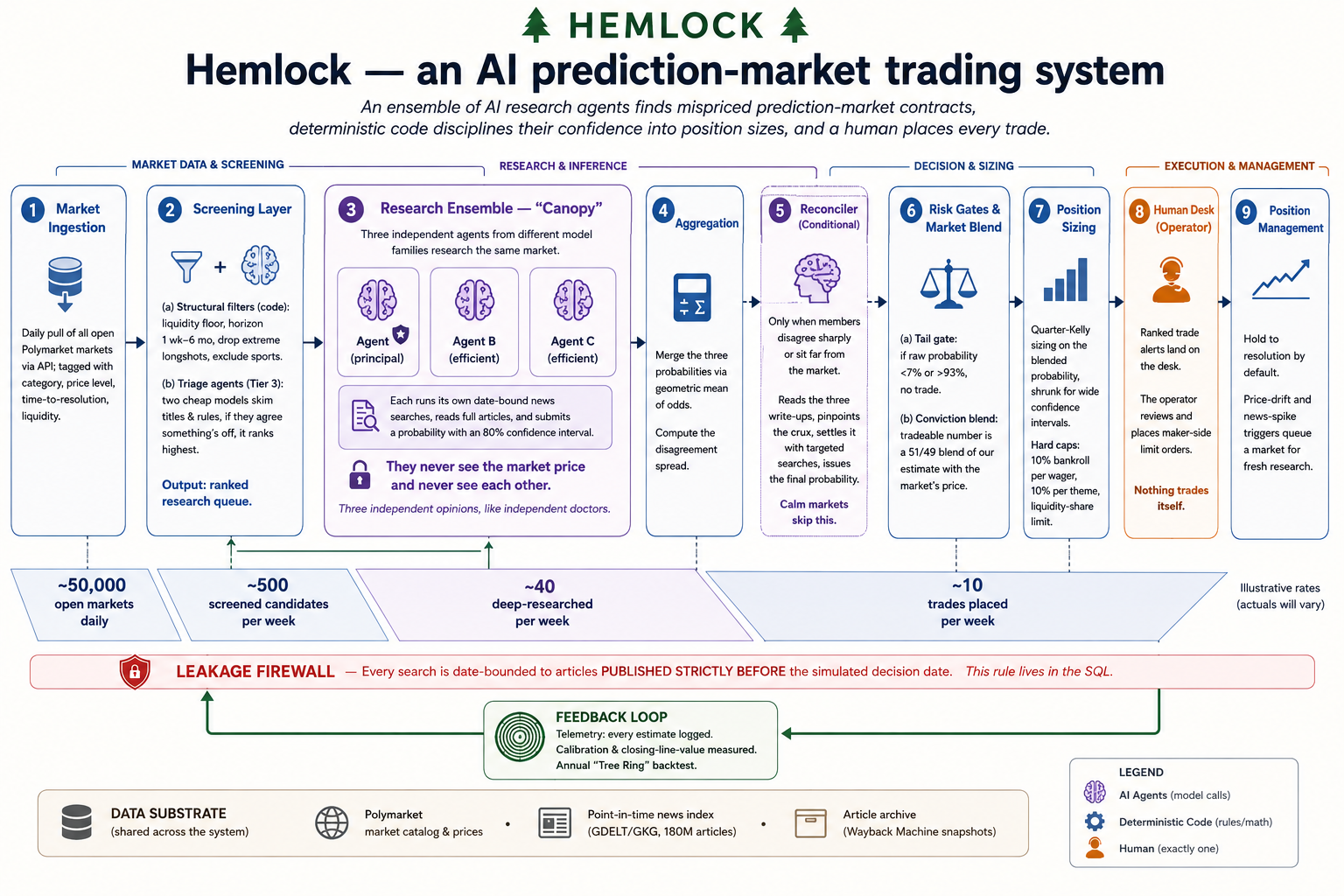
Canopy — an ensemble research engine that prices prediction markets: three independent AI analysts, a conditional reconciler, and a market blend, all validated in a 12-month walk-forward simulation before real dollars move. Nothing trades automatically.
Overall MATES System Design
The full live pipeline: market ingestion → screening → the Canopy research ensemble → risk gates & sizing → a human places every trade. (Rev 8/31.)
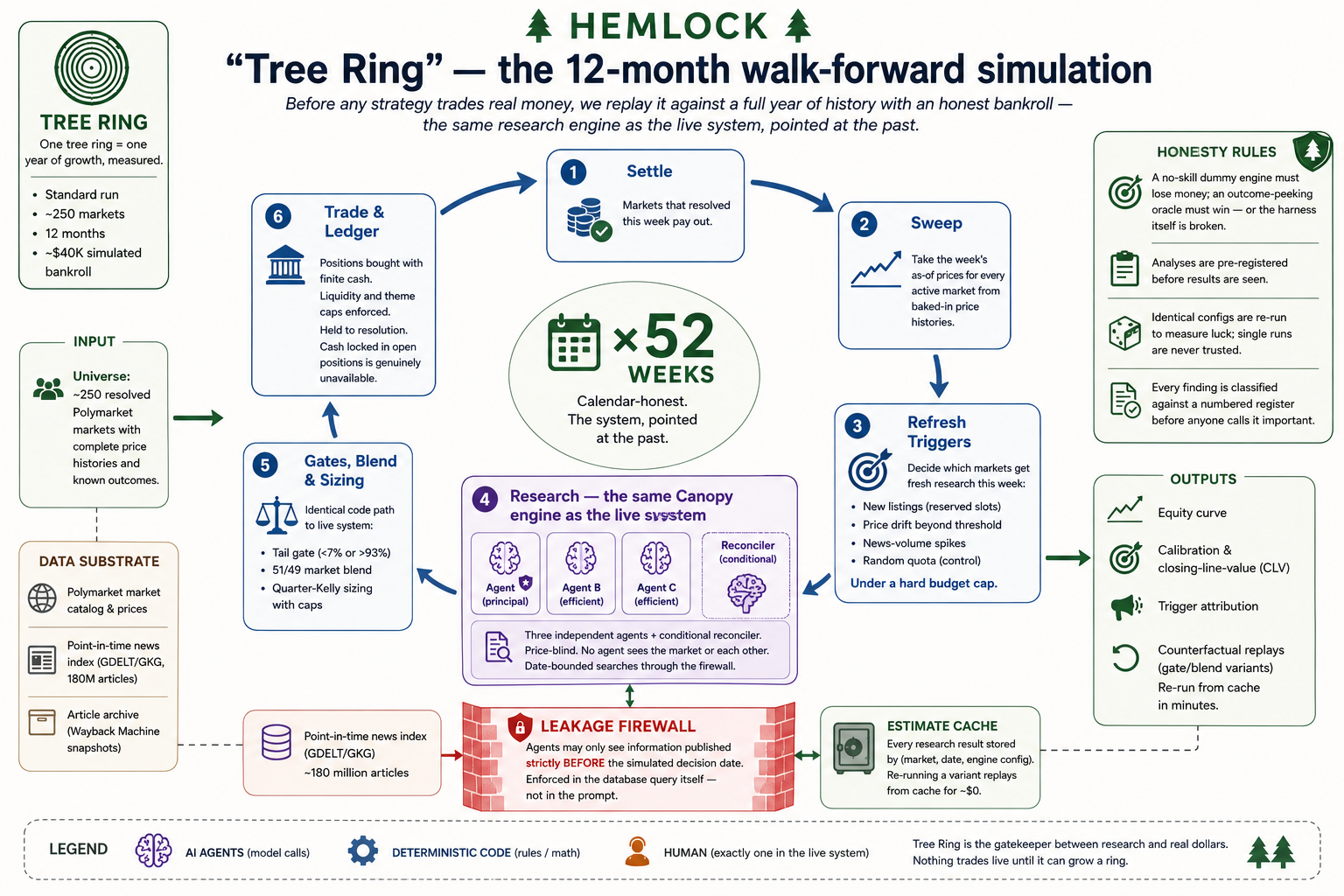
MATES Simulation Environment System Design
"Tree Ring" — how every strategy earns trust before real dollars: a 12-month walk-forward replay with an honest bankroll. (Rev 9/01.)
Previous designs — walk-forward SVG, Canopy component diagram & the single-principal era (kept for comparison)
Why this exists: the older backtest priced each market once at fixed points in its life and
assumed resolved capital was instantly re-bet — a flattering fiction. The walk-forward replays
the year the way a real desk lives it: money locks up, opportunities arrive on their own schedule,
and research costs money. The same harness is the A/B laboratory — different estimation
engines run the identical year, and cached estimates let sizing and allocation variants replay for
free. Clay steps are deterministic code;
the purple step is where the research agents run.
Why an ensemble: re-asking one model gives near-identical answers, but
different model families disagree in genuinely useful ways —
cross-model agreement carries measurable predictive value, and their spread doubles as a danger
gauge. Why price-blind: an analyst who can see the market price anchors to it; the price enters
only later, in deterministic code — as the
Reconciler's alarm and the 50/50 blend that turns extreme
disagreement with the crowd into a small position rather than a bet-the-house moment. The
Trading Desk is a human — nothing trades automatically.
The proving ground: before any configuration touches real dollars it replays 12 months of
history in a walk-forward simulation with an honest bankroll —
finite cash, positions lock until resolution, and every model re-evaluation must be justified by a
trigger and paid for.
What makes it agentic: the analysts and the reconciler are LLMs in a multi-turn
tool-use loop — each writes its own search queries, chooses
which articles to read in full, and iterates until it submits a schema-validated verdict; nothing
hands them a pre-built context blob. The same market-data layer is also exposed as a standard
MCP server (Model Context Protocol;
mates_mcp —
five self-describing, read-only tools: resolution rules, prices, order book, search, market
context) that any MCP client can connect to; it deliberately wraps no trading or account calls, so
no agent can move money through it. Inside the simulator the identical tool loop runs in-process for
speed and leak-tight determinism. Python + Flask, containers on GCP.
What's actually an agent: the Principal Research Agents are the real
LLM agents today — one per shortlisted market, each web-searching independently and returning a
schema-validated verdict. The Associate Research Agents are the cheap
triage tier that will let us screen far more markets than 24; that stage is
under construction and nothing runs through it yet.
Orchestrator, Deterministic Intake and
Managing Director are deterministic code, not autonomous agents — a
workflow runner, a filter/rank pass, and the fan-out. The Trading Desk is
you. Both agent tiers reach market data through a read-only
MCP tool layer (Model Context Protocol) — the agent chooses which
tools to call, which is what makes the research step agentic rather than fed a fixed context blob.
Python + Flask throughout, deployed as containers on GCP.
Active Positions Summarized
Phase 2 complete · 2026-08-24 — Phase 2 of Hemlock's 2026 strategy
is done: the Canopy research engine is built and validated in a 12-month walk-forward simulation. We are now
liquidating current positions, deploying the new system, and will re-deploy capital into new positions.
Banner updated 2026-08-24 (manual) · the positions summary below refreshes on its own schedule
This portfolio totals roughly $2,854 across two venues, with the large majority — about $2,550, or 89% of assets — sitting as uninvested cash on Polymarket US and no open positions there. The active exposure is concentrated entirely on Kalshi, where two "NO" positions (bets that a given event will not happen) worth about $303 in current market value are held, alongside a negligible $0.60 cash balance. Within Kalshi, the book is highly concentrated: one position, a NO bet on whether Miguel Díaz-Canel leaves his Communist Party post before 2027, accounts for roughly 93% of invested cost ($356 of $383), while a much smaller NO position on presidential impeachment before 2028 makes up the rest. Overall, the portfolio is mostly cash, with only a small, concentrated slice actively deployed in two directionally similar (both "NO") event-outcome contracts on one venue.
Summary auto-generated daily from the live portfolio's shape · last refreshed 9/1 2:01 PM PT
| Market | Side | Contracts | Cost | Value | P&L |
|---|---|---|---|---|---|
| Will Miguel Díaz-Canel leave First Secretary of the Communist Party of Cuba before Jan 1, 2027? | NO | 347 | $355.99 | $294.95 | $-61.04 |
| Will the President be impeached before Jan 1, 2028? | NO | 37 | $27.43 | $14.43 | $-13.00 |
| Total | — | $383.42 | $309.38 | $-74.04 |

MATES · Multi-Agent Trading Execution System
Illustrations: J.J. Audubon (1837) · M.V. Walcott, North American Wild Flowers (1925), public domain · data refreshed 9/2 12:09 AM PT